Thursday, May 24, 2012

Update: New USP General Chapter 1050.1


There is a new general chapter being prepared for inclusion in the United States Pharmacopeia (USP). It will be entitled “Design, Evaluation, and Characterization of Viral Clearance Procedures” and will be numbered 1050.1 to associate it with the current General Chapter <1050>.

A little history is called for to make this association more clear. Chapter <1050> first appeared in supplement 10 of USP23-NF-18 in 1999. It was, and still is, a verbatim copy of the International Conference on Harmonisation (ICH) document Q5A R1. In fact, it has an identical title: “Viral Safety Evaluation of Biotechnology Products Derived from Cell Lines of Human or Animal Origin”.

In many respects, U5P Chapter <1050> (and ICH Q5A R1) is similar in content and philosophy to the 1993 US FDA Points to Consider (PTC) document entitled "Characterization of Cell Lines used to Produce Biologicals".  Like the 1993 PTC, USP Chapter <1050> expresses an overall safety paradigm composed of three orthogonal approaches. These approaches may be summed up as consisting of testing of raw materials and cell banks, testing of unprocessed bulk harvest, and evaluation of viral clearance steps used during purification. Also like the 1993 PTC, Chapter <1050> describes potential sources of viral contamination, including raw materials and the cell substrate. The scopes of the documents are similar, applying to products derived from cell lines. Transmissible spongiform encephalopathy agents and live or inactivated intact viral vaccines and gene therapy vectors are out of scope and are covered by other guidance documents.

Due to the potential for introducing a viral contaminant through use of an infected cell substrate (e.g., SV40 in polio vaccine, or more recently PCV-1 in rotavirus vaccine), USP Chapter <1050> and the 1993 PTC address the concept of cell banking and the extensive viral testing that is required for cell banks at the Master Bank, Working Bank, and Limit of Cell Growth levels. The second approach of the safety paradigm is the requirement for lot-to-lot testing of the unprocessed bulk harvest. Testing is done at this level as opposed to purified product since purification is designed to eliminate viruses and therefore might preclude the manufacturer from discovering a viral infection. It is the intent of the regulatory agencies that potential opportunities for introduction of a viral contaminant be investigated and remediated, so testing is done prior to purification. The viral testing that is required for unprocessed bulk harvest is a subset of the tests done on the cell banks.

Both USP Chapter <1050> and the 1993 PTC discuss the limitations of viral testing as a sole means to assure viral safety, and this provides a segue for discussion of the need for viral clearance steps and the validation of the ability of such steps to clear viruses from the product. In fact, USP Chapter <1050> does a good job of providing the fundamentals of viral clearance evaluation, however there was a feeling expressed by some in the industry (and especially Mike Rubino, a member of the original ad hoc advisory panel for this chapter) that more detailed guidance on experimental design was needed. This, by the way, is true in general about Chapter <1050> (and IQH Q5A Rl upon which USP <1050> was based) that it is strong on philosophy but weak on specific methodological detail.

The original USP ad hoc advisory panel for Chapter <1050> revision was assembled with the purpose of updating the chapter to include this missing experimental detail. The panel went through each section of the existing chapter and added the detail that was felt to be lacking. This was done with the overall mandate to avoid introducing any new language that might conflict with the original language (and ICH Q5A Rl). The revised Chapter <1050> was published in the Pharmacopeial Forum in 2010. Responses obtained indicated that there was reluctance to modify in any way the language of this chapter without also modifying ICH Q5A. The situation as of February 2011 was described in an earlier posting.

As a result, the USP decided to keep Chapter <1050> intact and identical to ICH Q5A Rl.  A new ad hoc advisory panel was assembled with the purpose of producing a new chapter in the general information series that would be a companion to the existing Chapter <1050>. The new chapter received the number 1050.1 and provided the vehicle for adding the desired methodological detail.

The proposed new General Chapter <1050.1>, entitled "Design, Evaluation, and Characterization of Viral Clearance Procedures" consists of some background information on process evaluation and process characterization, then launches into experimental design for evaluating both inactivation and removal steps. The latter section includes some specific experimental design flow charts addressing virus removal by filtration and chromatography and virus inactivation. Along with the flow charts describing the design of the studies are description of the methods used to assess potential cytotoxicity or interference caused by the process materials themselves.

The subheadings of the background information are shown in the text box below.


The information presented under these subheadings reflects the panel's understanding of current regulatory expectations. Regulatory input obtained during the public comment period will assure that the panel's perceptions were correct. Discrepancies will be corrected as required.

Finally, a goal of the new chapter was to provide an updated list of the types of viruses that have been and may be used in viral clearance evaluations. For studies enabling clinical trials, it is common for evaluations to use a parvovirus such as MMV and a retrovirus such as X-MuLV as models. This provides a small non-enveloped virus to challenge filtration steps, as well as an enveloped virus to assess inactivation steps designed for lipid enveloped viruses. For BLA enabling studies, a few additional viruses may be selected from this updated list, keeping in mind that the viruses should represent a diversity of characteristics (envelope status, genome type, size, etc.).

The intention of the new chapter <1050.1> is that manufacturer’s may use the methods as appropriate to their own processes and will be able to cite the guidance in their descriptions of the study design. At the present time, no guidance having sufficient experimental design descriptions is available to cite in this respect. The planned date for publication of the proposed chapter in the Pharmacopeial Forum is January 2013.

Tuesday, May 1, 2012

Relative Humidity Specification at Refrigerated Conditions


By Dr. Scott Rudge

The ICH has established well known temperature and humidity standards for conducting stability studies that mimic the environments in various parts of the world.  Zones I and II correspond to cold and temperate areas respectively, such as North America and Europe, while Zones III and IV correspond to hot and dry or hot and humid climates, like Equatorial Africa, Brazil and lower altitude South America and southern Asia including India.  There are exceptions within these regions, to find out the zone for a specific country, you should reference ICH Q1F or WHO Technical Report Series No. 953, 2009.  These stability conditions are for pharmaceuticals meant to be stored at room temperature.  And it makes sense to consider relative humidity at room temperature, the amount of water in the air can be substantial.  But recently, we’ve had clients specifying a relative humidity in refrigerated conditions.  This is not an ICH requirement, but perhaps with very moisture sensitive products, it makes sense to specify this and control it.
Relative humidity is a fairly familiar concept.  We know that when it’s humid out, it feels hotter.  Your clothes don’t dry, and neither do you!  As I’m sure all the readers of these posts know, “relative” humidity is the amount of water vapor in the air relative the air that is saturated with water.  This is expressed most conveniently as the measured partial pressure of the water vapor in the air divided by the vapor pressure of water at the temperature of the “system”.  The vapor pressure of water is a strong function of temperature, as shown in the following graph:


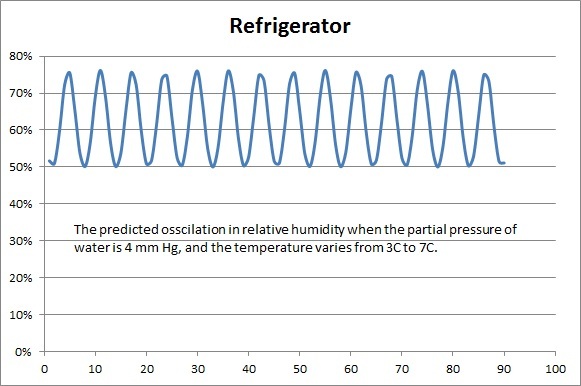
As the temperature goes towards 0°C, the vapor pressure goes to zero.  It doesn’t reach zero, as ice also has vapor pressure, but it gets close.  At 2°C, the vapor pressure is 5.2 mm Hg at 8°C, it is 8 mm Hg.  So, in the case of a refrigerator, where you might store pharmaceuticals, whatever humidity is in the refrigerator is divided by a very small amount of humidity that represents saturation.  In fact, you would predict that, at a constant partial pressure of water, say 4 mm Hg, the relative humidity would vary with an amplitude of 25% with a temperature range of 4 ± 2°C, as shown below.
 We tested this in one of our refrigerators at RMC, and found the actual situation to be a little worse, an amplitude of about 40%. The amount of water in the air in our 13.75 ft3 refrigerator is 1.65 grams.  That’s quite a bit of water in the air, but a relative humidity profile that seems more or less uncontrollable.
So what’s the answer?  It doesn’t seem that specifying a relative humidity range for a refrigerator is a great idea.  On the other hand, if you have water sensitive samples that are not otherwise protected, you are probably playing with fire.  The use of a desiccant and vapor impermeable overwraps that have been seal tested is probably a requirement.

Thursday, March 15, 2012

Moving Past the Bottleneck

By Dr. Scott Rudge

Is there a bottleneck in Downstream Processing? The membrane chromatography vendors certainly want you to think so.


The problem is in the efficiency of chromatographic purification.  Without a doubt, chromatography is slow and inefficient. A typical protein loading for commercial scale chromatography is 25 to 40 g/L, and a typical cycle is on the order of 8 hours.  So the productivity of a chromatography column is 3 to 5 g/L/hr.  Compare this to an aggressive microbial fermentation, which produces 10 g/L in a 40 hour fermentation (0.25 g/L/hr) or a very aggressive cell culture which produces 10 g/L of antibody in seven days (0.06 g/L/hr). Clearly, even with the inefficiency of chromatography, there is plenty of volumetric productivity to keep up with modern cell culture and fermentation.

As was pointed out in a previous blog, there is no total capacity difference between typcal chromatography resins and derivatized membranes, and the dynamic binding capacity, where membrane chromatography should be superior, is also not different.So membrane chromatography does not appear to be the answer.

One technology that could intensify the performance of chromatography is “simulated moving bed” chromatography. With simulated moving beds (or SMB), the non-productive volumes of the chromatography column are put into use. This is done by segmenting the column, or making a series of much smaller columns, each of which can be operated differently at any given time.  For example, a section of the column near the classic “inlet” would be regenerated after the product has passed through it.

A section of the column downstream of the product front would be equilibrated just before the product front entered it.

In its simplest form, the SMB column is thought of in four sections, one for feed, one for product, one for regeneration, and one for raffinate, as shown in the figure below:


(from Imamoglu, S., Advances in Biochemical Engineering/Biotechnology, Vol. 76, Springer-Verlag, Berlin, p 212 (2002).)


The flow of mobile phase moves countercurrent to the direction of switching of the columns, and the velocity of switching the columns is in between the velocity of the product and the next fastest or slowest contaminant.  In the configuration shown above the raffinate moves more quickly than the product (extract), and as the solid moves counterclockwise, the extract moves backwards to the elution zone.  Meanwhile, the fast moving raffinate is allowed to exit the loop to waste.  Column segments in Zone IV are regenerated and re-equilibrated to a condition where the extract is bound but the raffinate continues to travel down column. SMB can increase the productivity of chromatography resin by a large factor.  In the simplistic diagrammatic example, the productivity could be increased by a factor of 4.  Depending on the length of the zone required for separation, the increase can be much higher.

SMB has been used for the production of amino acids, enantiomers and many other small molecules. More recently, it has been used for purification of proteins such as albumin, antibodies and some artificial demonstration mixtures such as myoglobin/lysozyme.  Innovations such as the application of gradients to SMB have been developed.  This technology has the potential to reduce cycle times and increase efficiency by smarter use of existing resources.

Monday, February 13, 2012

UV-C versus small, non-enveloped viruses


Small, non-enveloped viruses (especially the circoviruses, parvoviruses, picornaviruses, caliciviruses, and polyomaviruses) and bacteriophage with similar characteristics represent a special challenge to the biologics industry.
In fact, contamination events have occurred with each of these virus families; in some cases more than once. Within the Circoviridae, the primary concern has been the porcine circovirus discovered in rotavirus vaccine. At least four contamination events involving the parvovirus, mouse minute virus, have been reported. The calicivirus vesivirus 2117 has contaminated biologics manufacturing processes on at least two occasions. The picornaviruses are a threat which has yet to be realized in the manufacturing context; but a viral safety test conducted for a biologics cell bank was the scene of a contamination with equine rhinitis A virus. The polyomavirus SV40 was found to have survived the formaldehyde inactivation used in the preparation of polio vaccines and therefore made its way into the doses of vaccine delivered to millions of individuals during the decade between 1955 and 1965 (being born in 1952, it is possible that the author received such tainted vaccine!).
The contamination events described above are, at least in part, a reflection of the ability of these viruses to withstand conditions that would lead to inactivation of other types of viruses. Inactivation strategies that are typically employed for viral safety include chemical (low pH, high pH, disinfectants, solvents, detergents, etc.) and physical (heat, irradiation, pressure, etc.) means. In a previous posting, the efficacy of gamma irradiation for inactivating various types of viruses within frozen animal serum was discussed. The use of UV-A in combination with riboflavin has also been discussed previously.
It is perhaps fortunate that the efficacies of different inactivation approaches are in many cases complementary. For instance, it appears that the efficacy of gamma irradiation for inactivation of viruses decreases as viral particle size decreases (although this relationship is not strictly linear). The outcome of this is that gamma irradiation does not appear to be particularly effective for inactivating small, non enveloped viruses from the circovirus, parvovirus, and polyomavirus families. On the other hand, ultraviolet radiation in the C range (254 nm is the most commonly employed wavelength) appears to be more effective for the inactivation of smaller viruses than for larger viruses (or bacteria).
The table below is a compilation of the UV-C inactivation constants (K, defined as the log10 reduction in titer per mJ/cm2 fluency) for various families of small, non-enveloped viruses. These K values represent inactivation of the viruses in a variety of matrices, ranging from water to protein-containing matrices such as albumin or complete culture medium). These results suggest that UV-C irradiation may be a viable approach for inactivating many of these problem viruses in raw materials or process intermediates used in biologics manufacture.

references for K values: * Lytle and Sagripanti 2005, ¶ Kowalski et al. 2009; † Maier 2007. The other values are the mean K values assembled by the author from the inactivation literature.
The one exception appears to be the polyomaviruses, which appear to be relatively resistant to the inactivating effects both of gamma irradiation and UV-C irradiation. This family of viruses may best be inactivated using high-temperature short-time treatment (HTST), though the efficacy of this approach for the polyomaviruses has yet to be demonstrated empirically.

Tuesday, January 31, 2012

Is Membrane Chromatography the Answer?

by Dr. Scott Rudge

Membrane chromatography gets a fair amount of hype.  It’s supposed to be faster, cheaper, it can be made disposable.  But is it the real answer to the “bottleneck” in downstream processing?  Was Allen Iverson the answer to the Nugget’s basketball dilemma?  I’m still skeptical.

The idea to add ligand functionality to membranes was not new at the time, but the idea really got some traction when it was endorsed by Ed Lightfoot in 1986.  Lightfoot’s paper pointed out that the hydrodynamic price paid for averaging of flow paths in a packed bed might not be worth it.  If thousands of parallel hollow fibers of identical length and diameter could be placed in a bundle, and the diameter of these fibers could be small enough to make the diffusion path length comparable to that in a bed of packed spheres, or smaller, then performance would be equivalent or superior at a fraction of the pressure drop.  This is undoubtedly true; there is no reason to have a random packing if flowpaths can be guaranteed to be exactly equivalent.  However, every single defect in this kind of system works against its success.  For example, hollow fibers that are slightly more hollow will have lower pressure drop, lower surface to volume ratio, lower binding capacity and higher proportional flow.  Slightly longer fibers will have slightly higher pressure drop, slightly higher binding capacity, carry proportionally less of the flow.  Length acts linearly on pressure drop and flow rate, but internal diameter acts to the fourth power, so minor variations in internal diameter would dominate performance of such systems. 
Indeed, according to Mark Etzel, these systems were abandoned as impractical for membrane chromatography based on conventional membrane formats that have been derivatized to add binding functionality.  As this technology has been developed, its application and scale up has begun to look very much like packed bed chromatography.  Here are some particulars:
1.       Development and scale up is based on membrane volume.   However, breakthrough curves are measured in 10’s, or even 70’s of equivalent volumes (see Etzel, 2007) instead of 2’s or 3’s as found in packed beds
2.       Binding capacities are less in membrane chromatography.  In a recent publication by Sartorious, the ligand density in Sartobind Q is listed as 50 mM, while for Sepharose Q-HP it is 140 mM.  In theory, the membrane format has a higher relative dynamic binding capacity, but this has yet to be demonstrated (see above)
3.       The void volume in membranes is surprisingly high, at 70%, compared to packed beds at 30%.  This is a reason for the low relative binding capacity.
4.       Disposable is all the rage, but there’s no evidence that, on a volume basis, derivatized membranes are cheaper than chromatography resins.  In fact, economic comparisons published by Gottshalk always have to make the assumption that the packed bed will de facto be loaded 100 times less efficiently than membranes, just to make the numbers work.  The cost per volume per binding event goes down dramatically during the first 10 reuses of chromatography resins.
It turns out that membrane chromatography has a niche, and that is for flow-through operations in which some trace contaminant, like the residual endotoxin or DNA in a product is removed.  This too can be done efficiently with column chromatography when operated in a high capacity (for the contaminant) mode.  But there is a mental block among chromatographers who want to operate adsorption steps in chromatographic, resolution preserving modes. This block has not yet affected membraners.  A small, high-capacity column operated at an equivalent flowrate to a membrane (volumes per bed or membrane volume) will work as well, and in my opinion more cheaply if regenerated.
These factors should be considered when choosing between membrane and packed bed chromatography.